


What a real SEO audit covers, and how to tell it from an automated report
A 90-page PDF of warnings is not an audit. A real audit explains what is holding your website back, why it matters for your business, and what to fix first. Here is what it should cover and the questions that expose a weak one.
 Barshad SitoulaSEO specialist · 7+ years · Dubai
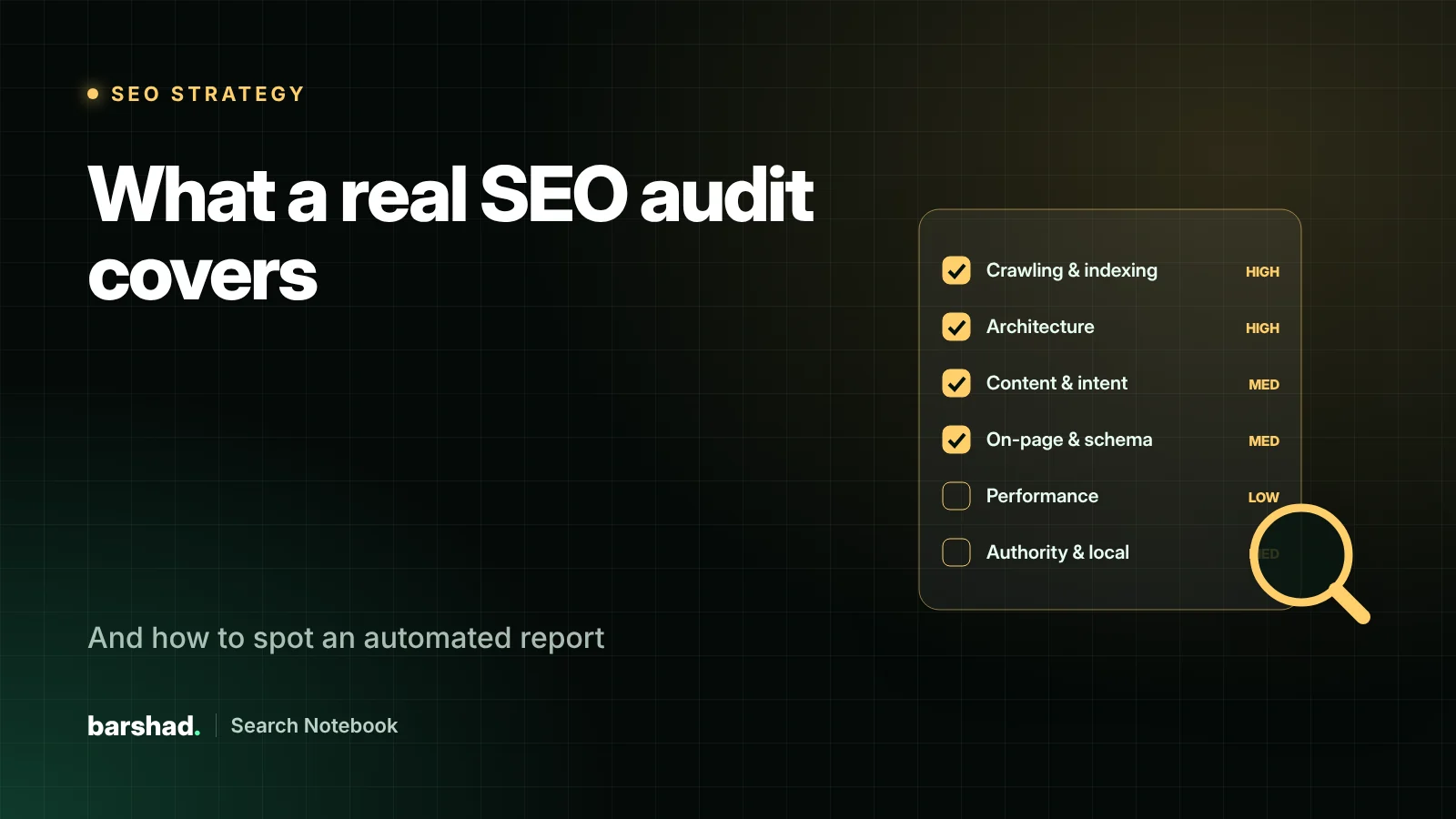
- An audit is a diagnosis with priorities, not a list of tool warnings.
- It should cover technical health, content and intent, authority, local signals and measurement.
- Every finding needs an impact, an effort estimate and a clear owner.
- A good audit is useful even if you never hire the person who wrote it.
Many businesses have received an “SEO audit” that was really a crawler export: dozens of pages of warnings, colour-coded scores and no explanation of what matters. It feels thorough. It rarely changes anything.
A real audit does three things a tool cannot. It explains why the website is not performing, it ranks problems by business impact, and it gives a plan someone can act on next week.
The six areas a real audit covers
1. Crawling and indexing
Can search engines find, render and index the pages that matter, and are they wasting time on pages that do not? This includes robots.txt, sitemaps, canonicals, redirects, status codes, duplicate and parameter URLs, JavaScript rendering and, for larger sites, server log analysis.
2. Site architecture and internal links
Does every important page have one clear job, sit close to the homepage and receive internal links with descriptive anchors? Are there orphan pages, or pages competing for the same search?
3. Content and search intent
Do pages match what people are looking for when they search? An audit maps your main searches to pages, finds gaps and overlaps, and identifies thin or outdated content.
4. On-page and structured data
Titles, headings, meta descriptions, images and schema, reviewed for relevance and click appeal, not just presence.
5. Performance and experience
Core Web Vitals from real user data where available, mobile usability and the practical things that stop people converting: slow forms, hidden contact details, intrusive pop-ups.
6. Authority, local signals and measurement
The quality of links and mentions compared with competitors, Business Profile health for local businesses, and whether Search Console, GA4 and conversion tracking are set up well enough to judge results.
The data a good audit uses
- Search Console: what Google indexes, which searches show you, and where clicks come from.
- Analytics and conversion data: which pages turn visitors into enquiries.
- A full crawl: how the site is structured and linked, as a search engine sees it.
- Rendering checks: what content exists once JavaScript runs.
- Competitor research: what the pages that outrank you do differently.
- Server logs, for larger sites: where Googlebot actually spends its time.
An audit that only uses a crawler sees the website. An audit that uses Search Console and Analytics sees the business.
Typical findings by type of website
| Website | Findings I often see |
|---|---|
| Local service business | One page trying to cover every service, weak Business Profile alignment, no call tracking |
| E-commerce store | Filter and parameter URLs wasting crawling, thin category pages, duplicate product content |
| Content or media site | Overlapping articles, outdated content, weak internal linking to money pages |
| Large generated sites | Index bloat, low-value templates, crawl budget spent on the wrong URLs |
What separates a useful audit from an automated report
| Automated report | Real audit |
|---|---|
| Lists every warning a tool found | Explains the few issues that hold the site back |
| Generic scores out of 100 | Findings tied to traffic, enquiries and revenue |
| Same template for every client | Specific URLs, examples and screenshots from your site |
| No order of work | Prioritised by impact and effort |
| Ends with “contact us to fix” | Usable by your own team or developer |
How findings should be written
Every finding in a good audit answers five questions:
- What is the issue, with examples from your website?
- Why does it matter for visibility or conversions?
- How big is the impact: high, medium or low?
- How much effort is the fix, and who should do it?
- How will you know it worked?
Questions to ask before you buy an audit
- Will I receive specific URLs and examples, or only summaries?
- Will you review my Search Console and Analytics data, not only crawl the site?
- How will findings be prioritised?
- Can my developer implement it without you?
- Is a walkthrough call included?
What a single finding looks like
Here is an example of a finding written the way a business can act on it:
Compare that with “Duplicate title tags found: 37”. One tells you what to do and why. The other tells you that a tool ran.
What happens after the audit
- Walkthrough. Go through the top findings together, so priorities are understood, not just read.
- Quick wins. Ship the high-impact, low-effort fixes in the first two weeks.
- Roadmap. Plan the larger items, such as page structure, content or migration, by quarter.
- Measurement. Set the baseline now, so you can show what changed later.
The audit as a hiring tool
An audit is also the best low-risk way to judge an SEO specialist before a longer engagement. You see how they think, how clearly they write and whether they understand your business. If the audit is generic, the retainer will be too.
Which audit do you need?
If you want a quick health check of crawling, indexing and key on-page signals, a focused audit is enough. If traffic has dropped, you are planning a redesign or you want a full roadmap, choose a deeper review. My audits are fixed-price: the General Audit at USD 20 and the Core Audit at USD 100, each for one website, with implementation available separately.
Frequently asked questions
How long does an SEO audit take?
It depends on the size of the website and the depth. A focused technical review of a small business site can be done in days. Larger or more complex sites take longer, especially when server logs or several markets are involved.
Can I just use a free SEO tool?
Free tools are good at finding symptoms such as missing titles or broken links. They cannot judge which issues matter for your business, how your pages compare with competitors, or what to fix first.
Does an audit include fixing the problems?
Usually not. An audit tells you what to do and in which order. Implementation can be done by your team, your developer or the auditor as a separate scope.
How often should I audit my website?
A full audit once a year is sensible for most businesses, plus a technical check before and after any redesign, migration or major content change.
SEO specialist and digital marketer based in Dubai with 7+ years across technical SEO, content strategy and WordPress development. Former Senior SEO Lead.
Related guides.
How much does SEO cost in Dubai? What you are really paying for
Two SEO quotes for the same website can be ten times apart, and both can be honest. Here is what…
Read article
How to hire an SEO specialist: 12 questions that separate experts from talkers
Whether you are a founder choosing a consultant or a hiring team interviewing for an in-house role, these twelve questions…
Read article
Why is my website not showing on Google? A 15-minute diagnosis
Before you pay for ads or a new website, find out which of three problems you have: Google cannot find…
Read article